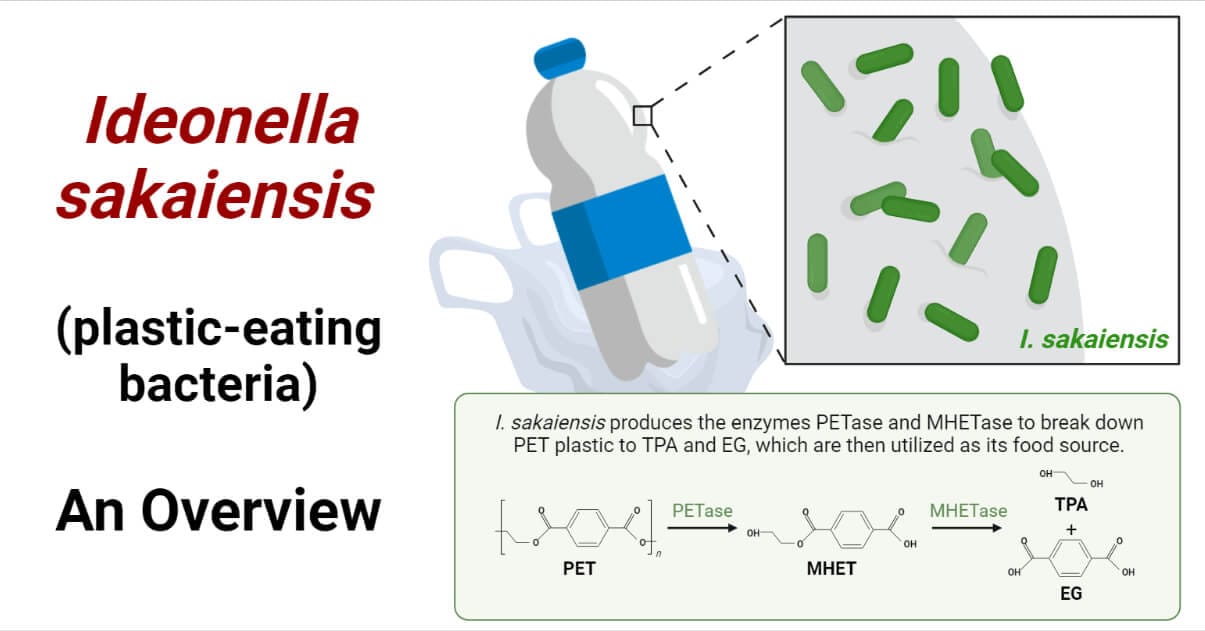
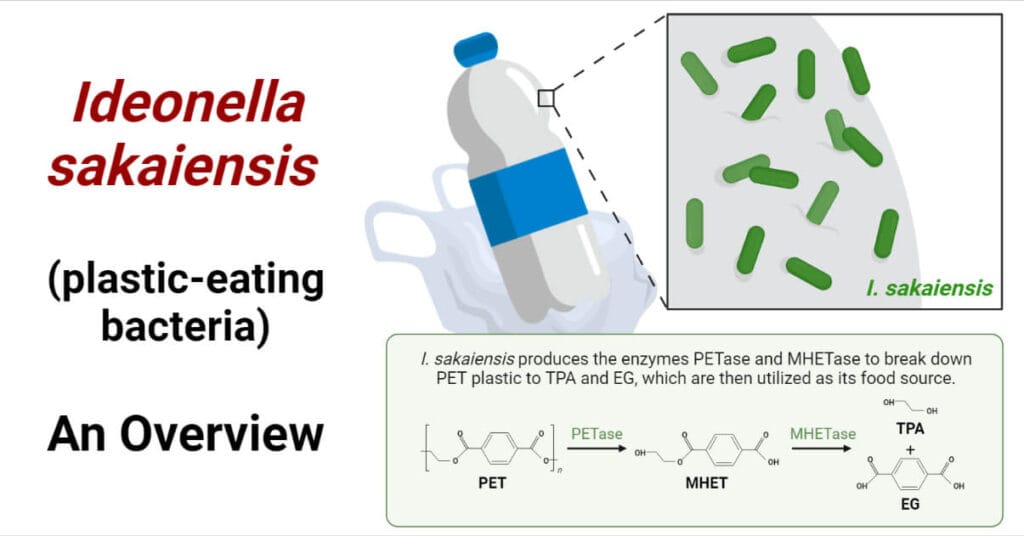
Ideonella sakaiensis is a novel bacterial species renowned for its extraordinary capacity to break down and metabolize a popular kind of plastic used in the manufacture of packaging materials, polyethylene terephthalate (PET).
Discovered recently in 2016 by a group of research scientists in Sakai city of Japan while researching the microbiome of PET-contaminated sediments at a plastic bottle recycling center, Ideonella sakaiensis has been renowned for its ability to degrade plastics. However, there is not much more known about its biochemical characters, genetics, and other characteristics. But this discovery has increased interest in the study of plastic breakdown and the potential for creating more environmentally friendly methods of handling plastic trash.
Long before I. sakaiensis was discovered in 2016, the genus Ideonella was established in 1995 under the proposal of Malmqvist A, Welander T, Moore E, Ternstrom A, Molin G, Stenstrom I. (Reference: https://lpsn.dsmz.de/genus/ideonella)
I. sakaiensis was discovered by a group of researchers led by Professor Kohei Oda of Kyoto Institute of Technology and Professor Kenji Miyamoto of Keio University, respectively. They were researching the microbial community of PET-contaminated sediments of a plastic bottle recycling facility in the Sakai City of Japan. During their study, they discovered that about 3/4th of the PET was degraded to CO₂. On further study, they found that a novel bacterium, now named Ideonella sakaiensis, first degrades and assimilates the PET by secreting the PET hydrolase (PETase) enzyme. Thus, degraded PET can be used by other microorganisms as a carbon source.
Habitat of Ideonella sakaiensis
I. sakaiensis was initially discovered from PET-contaminated soil, suggesting its main habitat to be the environment, mainly soil with enriched plastic wastes. They are found to live in oxygen-rich moist soil and sewage sludge.
Morphology of Ideonella sakaiensis
Ideonella sakaiensis is a Gram-negative, rod-shaped, motile, non-sporing, non-pigment-producing, monotrichous bacterium. They typically measure about 1.2 to 1.5 μm in length and 0.6 to 0.8 μm in width, giving the appearance of a bacillus under the microscope.
Cultural Characteristics of Ideonella sakaiensis
Ideonella sakaiensis is non-fastidious bacteria that can be grown in common culture mediums like nutrient agar medium and tryptic soya agar medium.
They are aerobic, mesophilic bacteria that commonly grow at a temperature range of 15 to 42°C with optimum growth at 35±2°C (30 to 37°C) and a pH range of 5.5 to 9.0 with an optimum pH range of 7 to 7.5. (Reference: doi:10.13145/bacdive140803.20230509.8)
In NBRC no. 802 Agar Medium, I. sakaiensis gives small, circular, raised colonies of 0.5 to 1 mm with an entire margin. The colonies are non-pigmented and creamy translucent in appearance.
Similar colonies are found in Nutrient Medium and Trypticase soy broth agar medium. The bacterium is also grown in Tryptone soya broth.
Biochemical Characteristics of Ideonella sakaiensis
2. Tanasupawat, S., Takehana, T., Yoshida, S., Hiraga, K., & Oda, K. (2016). Ideonella sakaiensis sp. nov., isolated from a microbial consortium that degrades poly(ethylene terephthalate). International journal of systematic and evolutionary microbiology, 66(8), 2813–2818. https://doi.org/10.1099/ijsem.0.001058)
Identification of Ideonella sakaiensis
There is no well-devised biochemical key to identify the Ideonella sakaiensis bacterium. Phenotypic identification can be made based on the above-mentioned biochemical characteristics and microscopic observation together with the report of electron microscopy suggesting the presence of a single flagellum.
Molecular identification using the polymerase chain reaction (PCR) is the only available accurate method to identify Ideonella sakaiensis.
Potent Application of Ideonella sakaiensis
Being a persistent and not-easily biodegradable material and due to its extensive use and discard in the environment, plastic is the most intractable waste posing a catastrophic threat to the ecosystem. Lots of strategies have been built and placed to control the bulk of plastic waste and manage the existing plastic waste; but, none of them are effective enough. In this context, a plastic-eating bacterium such as Ideonella sakaiensis can be a mighty option to aid in the process of plastic waste management.
Some potent applications of Ideonella sakaiensis can be summarized as:
Plastic Upcycling
Upcycling is the process of converting one material into another chemically different material. I. sakaiensis can enzymatically degrade plastic, mainly PET, into other forms like mono(2-hydroxyethyl)terephthalate (MHET), ethylene glycol, etc. These products can be used by the same bacterium or other bacteria and even be modified chemically into several other products.
Bioremediation
The biological management of environmental wastes is called bioremediation. There are scanty organisms that are found to remediate plastic waste; however, their potential to control plastic waste is questionable because of their slower rate to degrade the plastics. In this context, the newly identified bacterium, Ideonella sakaiensis can be a potential being to aid the plastic bioremediation process.
Industrial Application
PETase and MHETase enzymes produced by Ideonella sakaiensis have potential use in industries production producing plastic products and managing solid and/or sewage wastes.
Mechanism of Plastic Degradation by Ideonella sakaiensis
Ideonella sakaiensis is found to be able to degrade polyethylene terephthalate (PET) type plastic. This type of plastic is widely used in the manufacture of plastic bottles and packaging materials.
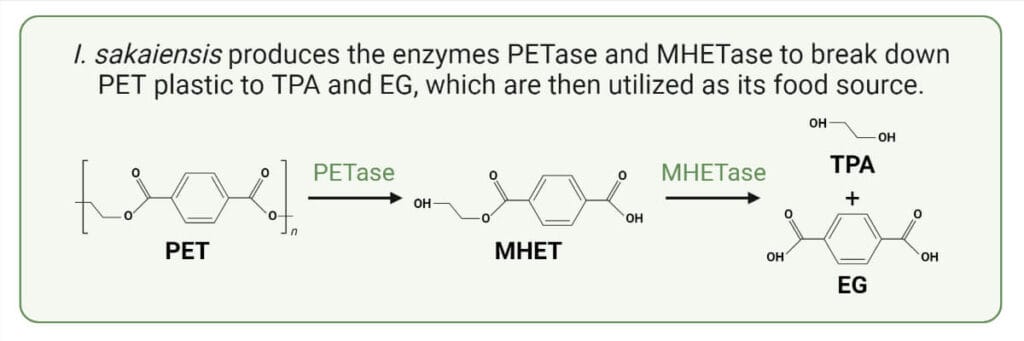
Ideonella sakaiensis adhere to the PET plastic surface using their flagellum. Once adhered, they secret PET-degrading enzyme, the PET hydrolase (PETase) enzyme on the surface of the plastic. The PETase enzyme breaks down the PET polymer into mono (2-hydroxyethyl) terephthalic acid (MHET) and a trace amount of terephthalic acid (TPA), bis (2-hydroxyethyl) terephthalic acid (BHET), and ethylene glycol (EG) as secondary products. The BHET is an intermediate product that will be converted into MHET.
Another enzyme secreted by Ideonella sakaiensis, the MHET-degrading enzyme commonly known as MHET hydrolase or MHETase, then converts thus formed MHET into two monomers, terephthalic acid (TPA) and ethylene glycol (EG).
The resulting ethylene glycol is taken up by Ideonella sakaiensis and other bacteria and readily metabolized as a carbon source. Mainly they are metabolized to acetyl-CoA and then oxidized in the tricarboxylic acid (TCA) cycle to CO2 yielding reduced nicotinamides which are used in the oxidative phosphorylation process to generate the energy molecule, ATP.
The terephthalic acid (TPA) is more recalcitrant, but once inside the cell of Ideonella sakaiensis, the enzymes 1,2-dihydroxy-3,5-cyclohexadiene-1,4-dicarboxylate dehydrogenase and terephthalic acid-1,2-dioxygenase catalyze the breakdown of TPA into protocatechuate. The protocatechuate is further catalyzed and incorporated into other metabolic pathways like the TCA cycle producing ATP and CO2.
(References: Pirillo, V., Pollegioni, L., & Molla, G. (2021). Analytical methods for the investigation of enzyme‐catalyzed degradation of polyethylene terephthalate. The Febs Journal, 288(16), 4730-4745. https://doi.org/10.1111/febs.15850 Willetts A. (1981). Bacterial metabolism of ethylene glycol. Biochimica et biophysica acta, 677(2), 194–199. https://doi.org/10.1016/0304-4165(81)90085-4 https://www.uniprot.org/uniprotkb/Q5D0X4/entry https://www.uniprot.org/uniprotkb/Q3C1E2/entry https://www.gbif.org/species/165596032)
There is yet much to learn about this novel bacterium’s more precise mechanism of PET hydrolysis.